Wednesday, March 27, 2024

Safety Second (1950)


For me and I am sure for many other cartoon fans, Safety Second is a Fourth of July tradition. 

In this short film, Jerry tells his little friend Nibbles not to play with fireworks but instead to keep the Fourth of July, "Safe and Sane." Nibbles of course does not listen to this at all. This soon leads to a big firework fight between Tom and the two mice, when Tom decides to play with fireworks as well. 

This is simply a delightful film. It has everything one might want from a chase cartoon. The idea of a slapstick cartoon revolving around fireworks makes you wonder why more slapstick cartoon series have entries about the Fourt of July. The sheer amount of milage this film gets out of fireworks gags is simply fantastic. Because these gags are so well timed and delivered the film never feels too repetitive and never stops being a lot of fun to watch. The character animation also adds a lot to this film. Again, it makes these pantomime characters feel more real and alive to us than many live action movie characters. This is especially true when it comes to the interactions between Jerry and Nibbles. The animation not only completely captures who these characters are but what their relationship with each other is. 

Unlike many theatrical cartoons, this film was actually released around the holiday, it revolves around. It first went to movie theaters on July 1, 1950. The credited animators on this film are Ray Patterson, Ed Barge, Kenneth Muse, Irven Spence and Al Grandmain. This is the first Tom and Jerry film to feature "Made in Hollywood U.S.A." at the end of the cartoon. It continued to appear on all the Hanna-Barbera theatrical Tom and Jerry shorts. 

Below is the movie poster for this film. 


Thursday, March 21, 2024

Jerry and the Lion (1950)


This is one of the many Tom and Jerry films where Jerry befriends another animal. In this cartoon, the other animal is a lion. Though this is the only theatrical short film to feature this lion, he would later appear in more Tom and Jerry media. He would appear in multiple episodes of TV's The Tom and Jerry Show (the 2014 version), as well as an episode of HBO Max's Tom and Jerry in New York entitled Mousequerade (2021). He would also be an unlockable character in the 2002 video game, Tom and Jerry in War of the Whiskers. The Tom and Jerry Wiki lists this as being the same lion who would appear in The Tom and Jerry Comedy Show episode, Under the Big Top (1980) and Tom and Jerry Tales episode, You're Lion (2008). 

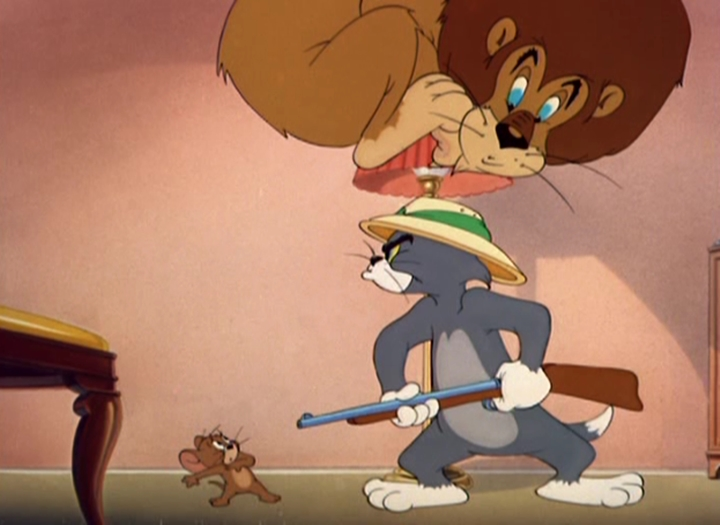
In this short film, Tom hears about a ferocious lion that escaped from a circus. A terrified Tom locks and bars all the doors while holding a gun to protect himself. The lion does find its way into the house and befriends Jerry. He tells Jerry to help him from not being sent back to the circus. Jerry must help get his new friend back to Africa, while keeping him a secret from Tom. 

This is a simply wonderful cartoon. While it may not have as many great gags as some of the earlier Tom and Jerry films, the gags that work here are fantastic. The gag involving the umbrella is one of my favorite Tom and Jerry gags ever. The timing on this gag is perfect and it takes you by surprise the first time you watch it. This whole film also benefits from some great character animation. Once again the animation truly brings these characters to life. You can always tell just what Tom and Jerry are thinking without them having to say a word. Often times the looks on Tom's face (or even the lion's) make the gags even funnier. The lion is also a great character who works very well with our friends Tom and Jerry. 

The credited animators on this film are Irven Spence, Ed Barge, Kenneth Muse and Ray Patterson. The cartoon would be reissued to theaters in 1957. 

Below is the movie poster for this film. While this is better than many of these movie posters, it is still far from perfect and the characters are definitely off-model. 


Monday, March 11, 2024

Texas Tom (1950)


The above image of Tom of Tom serenading a lovely cowgirl cat is one that is rightfully ingrained in the minds of classic cartoon fans. That is because the scene it comes from is true classic Tom and Jerry at its best. In fact, the whole cartoon is a delight.  

The film begins with Tom and Jerry having their typical slapstick fight, this time out west. Suddenly a big car drives by and drops off a beautiful cowgirl cat and Tom is immediately smitten. Tom serenades her by lip-syncing to a record he makes Jerry play. This naturally makes Jerry very angry, and he does all he can to spoil Tom's chances at romance. 

This is a top-notch film in every respect. This is another fast-moving cartoon that brings us gag after gag. The pure energy this film moves with, makes it hard not to have a good time watching. On top of this, every single joke lands here. This is only helped by William Hanna's timing again being absolutely perfect. The whole film is again full of great character animation. The scene with Tom serenading the cowgirl cat is not only great because of the gags, but also because of the great animation. The look on Tom's face as he tries to keep the lip-syncing ruse up when Jerry messes of the speed of the record is even funnier than the gags themselves. This animation as well as being funny also makes Tom more real to us as well. We can see what is going through his mind as he tries to figure out how to continue to lip-sync to this. 

This cartoon is also a pure delight for fans of cowboy music (like me). A couple of Cowboy songs are used on the soundtrack, and both are a lot of fun. If You're Ever Down in Texas Look Me Up is a great novelty song written by Terry Shand and 'By' Dunham. Phil Harris had a hit off this song in 1946, which you can listen to below. In this cartoon Ken Darby sang the song. 


I Tipped My Hat and Slowly Rode Away, a novelty song written by Larry Markes and Dick Charles is used in the film's opening. This duo wrote such songs as Mad About Him, Sad About Him, How Can I Be Glad Without Him Blues, Along the Navajo Trail, It Takes a Long, Long Train with a Red Caboose to Carry My Blues Away and May You Always. In this cartoon the song is sung by The Kings Men, who had previously recorded the song in 1947 for an episode of the Fibber McGee and Molly radio show. You can listen to that below. 


The cowgirl cat, who Tom falls for would later appear in an episode of TV's The Tom and Jerry Show entitled Day of the Jackalope (2014). She would later be a playable character in the 2019 online game Tom and Jerry Chase. That game would give her the name Tara. 

The credited animators on this film are Ed Barge, Kenneth Muse, Ray Patterson and Irven Spence. Clips for this cartoon would later be used in the Tom and Jerry cartoons, Smitten Kitten (1952) and Cruise Cat (1952). Tom's cowboy outfit from this film was later used in the 2003 video game, Tom and Jerry in War of the Whiskers.

Below is the movie poster for this film. This is much better than the average Tom and Jerry movie poster of this time. 


Tuesday, March 5, 2024

Saturday Evening Puss (1950)


Saturday Evening Puss is only the second Tom and Jerry film of the 1950's and proves that in this new decade the cat and mouse duo were still at the top of their game. 

In this short film, Tom's owner leaves for a bridge game. Tom then decides to throw a party with all his cat friends. The party involves loud music, which makes it impossible for Jerry to go to sleep. Jerry tries to tell them to stop the party, but Tom and his friends simply brush the mouse off. Jerry decides that this means he has to get revenge on the various cats. 

This is a top-notch cartoon in every way. The whole film is full of a great sense of energy that never lets up. From start to finish, this cartoon moves by at a fast pace that makes it still a lot of fun no matter how many times you watched it. Throughout this fast-paced film, there is gag after gag after gag. Most of these gags are simply wonderful and there are a lot of great laughs to be had here. Not one gag in the entire film misses. Each gag is also made better by how simply perfect William Hanna's timing was in this film. While there have been many great cartoon makers, few had the incredible sense of timing that William Hanna did, and this film is a perfect showcase for his talent. The music is also simply wonderful. For a cartoon where the story revolves around music, this is very important. Luckily the music is just as fast paced and fun as the action on screen. Not only does the music enhance the action on the screen, but I would still enjoy just simply listening to this music if it wasn't attached to the cartoon. The ending of this film is especially perfect as it twists our expectations of how a Tom and Jerry cartoon should end. 

-This film features Tom's owner, who is known to many Tom and Jerry fans as Mammy Two Shoes. As many Tom and Jerry fans know, you rarely see her face on screen. This cartoon is one of the rare exceptions as you can briefly see her face as she is running home towards the end. However, in the Tom and Jerry comics and story books, her face was shown much more often than in the cartoons. Mammy Two Shoes being a bit of a black stereotype has been censored in various TV airings of these cartoons. This film features the strangest version of that. Often times in the 1960's June Foray would provide a different voice for the character and the character would have her skin color re-colored. The censorship of this film took a very different approach, where Mammy is replaced by a white teenage bobbysoxer girl. Instead of going to a bridge game, she was going to a dance hop. A VHS version of this cartoon had an odd mistake, with the animation from the censored version and the audio of the original. 

The credited animators on this film are Ed Barge, Irven Spence, Kenneth Muse and Ray Patterson. However, the Tom and Jerry Wiki states, "Despite the credit, Ray Patterson does no animation on this short." The cartoon would be reissued to theaters in 1957. It would also be included in the feature length compilation, Tom and Jerry Festival of Fun (1962). Though this movie featured no new animation, Jerry's Diary (1949) was used as a framing device to make it feel like a feature length movie instead of simply a selection of cartoons. The cartoons included in this movie were Old Rocking Chair Tom (1948), The Little Orphan (1949), Jerry’s Cousin (1951), Professor Tom (1948), Mouse Cleaning (1948), Yankee Doodle Mouse (1943), Mouse Trouble (1944), Nit-Witty Kitty (1951), Push-Button Kitty (1952) and Saturday Evening Puss.

Below is the movie poster for this film. 


Monday, February 26, 2024

Little Quacker (1950)


Little Quacker was the first Tom and Jerry film of the 1950's. It is also the film debut of Quacker, the small duck with a baby like voice (provided by Red Coffey). The character would appear in 7 theatrical cartoon shorts. However, the character would stay fresh in the minds of William Hanna and Joseph Barbera. They would create a very similar character named Yakky Doodle for the various Hanna-Barbera TV series. Yakky Doodle would even receive his own segment on The Yogi Bear Show. Quacker, himself would even appear in one episode of Hanna-Barbera's later TV series, The Tom and Jerry Show. This episode was entitled The Lost Duckling (1975). Quacker would later appear in such Tom and Jerry video games as 2003's Tom and Jerry in War of the Whiskers (where he is an unlockable character) and 2000's Tom and Jerry in Fists of Furry. In both of those games, he is simply called Duckling. He would also as early as the mid-1950's as a regularly appearing character in the Tom and Jerry comic books. 

As this short film begins, a mother duck leaves her nest and egg behind for a moment. Tom then takes the egg and goes to cook it. When Tom cracks the egg the little duckling comes out. Tom then decides to cook the little duckling inside. Jerry sets out to save Quacker from Tom. 

This is probably the best Tom and Jerry cartoon to feature Little Quacker. While some of the later films with this character would try to be too cutesy for this series, this cartoon never falls into that trap. Instead, this is simply a pure classic Tom and Jerry cartoon. The film is full of great slapstick gags and the cuteness of Quacker never gets in the way of this being first and foremost a funny cartoon. There are plenty of slapstick gags throughout and many of them are quite funny. Like we have come to expect from these cartoons, William Hanna's timing is perfect here. Quacker is also very well utilized here. His presence helps make this film a nice departure from the usual Tom and Jerry formula, while still keeping what makes this series work. Watching Jerry and Quacker team up against Tom, leads to a lot of fun moments here. Quacker also has great chemistry with Jerry and the two play well off each other. Also, Quacker is not given too much dialogue here. This is important as too much dialogue from a supporting character can distract from our non-speaking main characters. This cartoon also has a great ending. 

The credited animators on this film are Ed Barge, Kenneth Muse, Ray Patterson and Irven Spence. The cartoon would be reissued to theaters in 1957. The cartoon would also later be adapted in the 1953 children's book, Tom and Jerry Meet Little Quack

Below is a typically ugly movie poster for this film. 


Wednesday, February 21, 2024

Tennis Chumps (1949)


This short film marks the last Tom and Jerry cartoon of the 1940’s. Though it may not be the best-known Tom and Jerry cartoon, it is a solid fun film that makes for a perfect ending for the cat and mouse duo’s best decade. 

In this short film Tom and Butch are having a tennis match. Tom makes Jerry carry all of his equipment. This is a job Jerry is not too fond of and he does everything he can to sabotage Tom's game. 

This is a wonderful cartoon. The whole film moves at a fast pace and provides gag after gag. Despite this there is not one weak gag in the whole film. Many of the gags are even laugh out funny. The amount of truly clever slapstick gags this cartoon was able to get from tennis alone is absolutely remarkable. Not only are the gags wonderful but the delivery is perfect. William Hanna's timing has never been better than it is here. Every gag is timed perfectly. Also helping is some incredible animation. Though this is a fast-paced film that constantly jumps from one gag to another, it still makes room for some fantastic character animation. This character animation makes all three characters seem perfectly real to us and let us know what is going through their minds at all times. To be able to do this, while keeping the cartoon moving at a breakneck speed is an incredible feat. That fact that the filmmakers are able to do this and make it seem so natural and effortless shows the pure mastery that was behind the best Tom and Jerry cartoons. Scott Bradley's score here is also wonderful, especially a lively rendition of All God's Chillun Got Rhythm. This film shows Tom and Jerry at their best and is a perfect coda to the duo's greatest decade/

The credited animators on this cartoon are Ray Patterson, Irven Spence, Ed Barge and Kenneth Muse. The film would be reissued to theaters in 1957 and again in 1965. 

In 2006, Turner Broadcasting edited 1,700 cartoons in their library for when they aired in the UK. This was after the Office of Communications received a complaint about two Tom and Jerry cartoons (Tennis Chumps (1949) and Texas Tom (1950)). Their complaints about these cartoons were that the films included scenes with characters smoking and there for it was deemed inappropriate to air these cartoons on TV channels heavily aimed at children. Turner Broadcasting issued the following statement, “Turner recognizes that it is not suitable for cartoons aimed at children to portray smoking in a cool context and has additionally pledged to review the entire Hanna-Barbera catalog to remove scenes that appear to glamorize or encourage smoking.” Personally, I grew up watching these cartoons on TV and have never smoked in my life.  

Below is the movie poster for this cartoon. Though not perfect it is much better than many of the movie posters for this series. 


Thursday, February 15, 2024

Jerry's Diary (1949)


Every cartoon fan is familiar with what is called a cheater cartoon. This is to say a cartoon that is mostly made up of clips from previous entries in the series. Jerry's Diary is the first cheater cartoon in the Tom and Jerry series. This short film includes clips from The Yankee Doodle Mouse (1943), Mouse Trouble (1944), Tee for Two (1945) and Solid Serenade (1946).

This short film starts with Tom outside Jerry's hole about to get revenge on his foe. However, Tom then overhears a radio announcer saying that it "Be Kind to Animals Week." Tom is swayed by the words of the radio announcer and decides that he is going to be kind to Jerry. He comes back with gifts for Jerry and knocks on the wall to get Jerry's attention. However, Tom finds that Jerry is not home. He also discovers that Jerry's diary is out. Tom gives into temptation and reads the diary. After reading of the previous fights between the two, Tom gets angrier and angrier. 

This film works in the most important aspect for a cheater cartoon. That is to say that the new footage is a lot of fun. The basic storyline is clever and well executed. There are some good gags in this new footage and some great character animation. I love the character animation that takes place when Tom is listening to the radio announcer. You can see him thinking and taking this all in. This is animated in a way that makes Tom feel completely real to us without him saying a word. Equally great is Tom going from feeling kind and generous to devious when he sees Jerry's diary. This is again captured in great character animation that truly captures who Tom is as a character. The ending gag is predictable but still funny and satisfying. 

However, this film does suffer from the same flaws as many other cheater cartoons. The clips are often too short, and the gags often work better in the context of the original cartoons. To me this type of cheater often works better in a longer format (where we get to see a larger portion of the older clips instead of isolated gags), then in the short 6-to-7-minute format. Still, it works well enough here.

Even with this being a cheater cartoon, a clip of the new footage made for this film would later appear in a later cheater cartoon, Matinee Mouse (1966). The credited animators on Jerry's Diary are Kenneth Muse and Ed Barge. This film was reissued to theaters in 1958. 

Here is an ugly movie poster for this film. Jerry is incredibly off-model. 


The Karate Guard (2005)

  When I started this blog, my goal was to review every one of the theatrically released Tom and Jerry short films. Well, I have finally rea...